In the Game "Stray" You Play as a Kitty
I'm sure the game has other qualities, too.

Stray, an objectively adorable third-person cat simulator, opens with you and your cat friends sitting around an abandoned industrial site. Right from the outset, the game places many tools in the hands of the player. You can nuzzle one of your cat friends, have a half-assed scratch fight with another, or lie down next to the third one. By this point, with all that in mind, Stray is unequivocally the Game of the Year, but it continues to exist beyond its first two minutes. Spoiler warnings are for nerds.
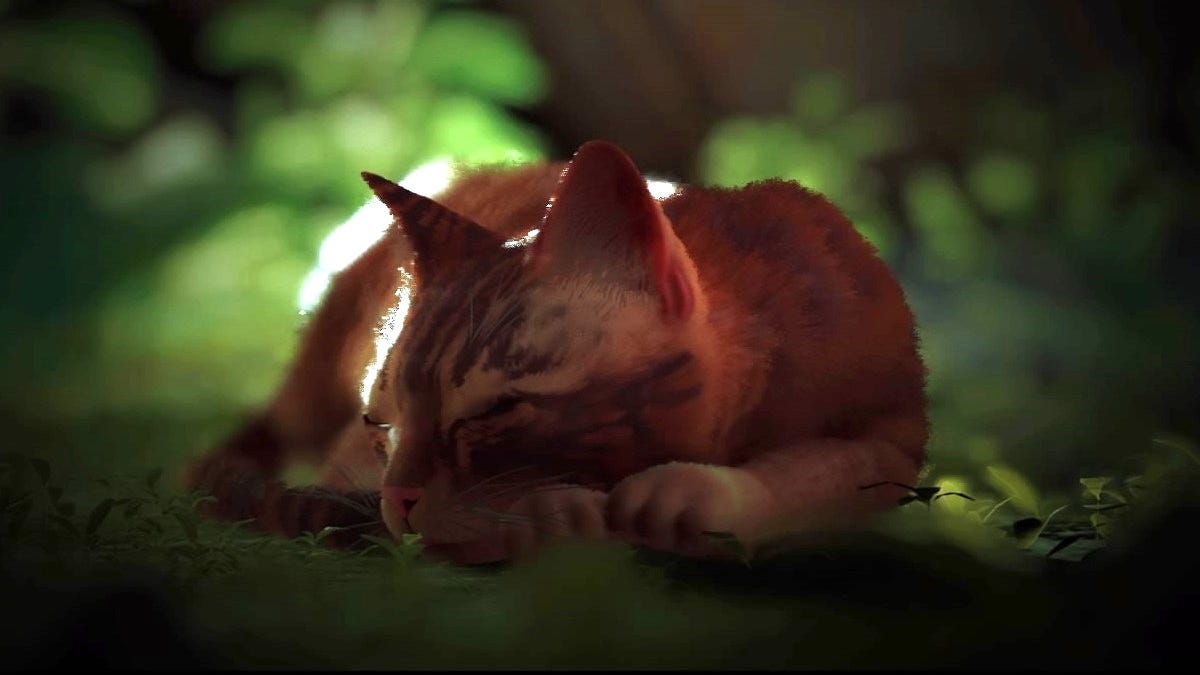
After having a nap you wake up the next morning and decide to go somewhere else. You, the orange cat, and your three friends, the black cat, the white and orange cat, and the other white and orange cat, wander through an overgrown facility in search of nothing in particular. Here you learn that you can press “B” to meow, and when you meow the other cats meow back at you. Think of it like Fallout 4 but with better dialogue. Later on, you learn you can drink water from puddles, and alternately tap the left and right triggers to sharpen your claws on a tree trunk. This opening section does a great job of showcasing how well realised orange cat is. The animations feel authentic. He slinks, he pounces, he scuttles about like’s on a cloud, he arches his back both ways, his ears twist around, he cleans himself when idle. You keep having moments where you’re like: “Oh my god, he’s doing that thing.” They’ve recorded real cat sounds and tied them to the player’s actions. A long fall on a large jump will result in a little “blrrp” from orange cat as he lands. Jumping itself is completely straightforward. All you need to do is go up to something that seems like it might be jumpable and press “A.” None of these objects presents much of a challenge as you are a cat. That is until you come across a fearsome pipe. The other cats manage to jump across the pipe, but as the orange protagonist goes to jump, the pipe comes loose and he falls. He slides down a concrete shelf and tries to hang on as he slips off the ledge. It’s a heartbreaking scene, as your cat friends watch as you fall down a black abyss. You land on your feet, but orange cat hurts his leg and limps for a little bit. Tired and hurt, the orange cat decides to take a nap.
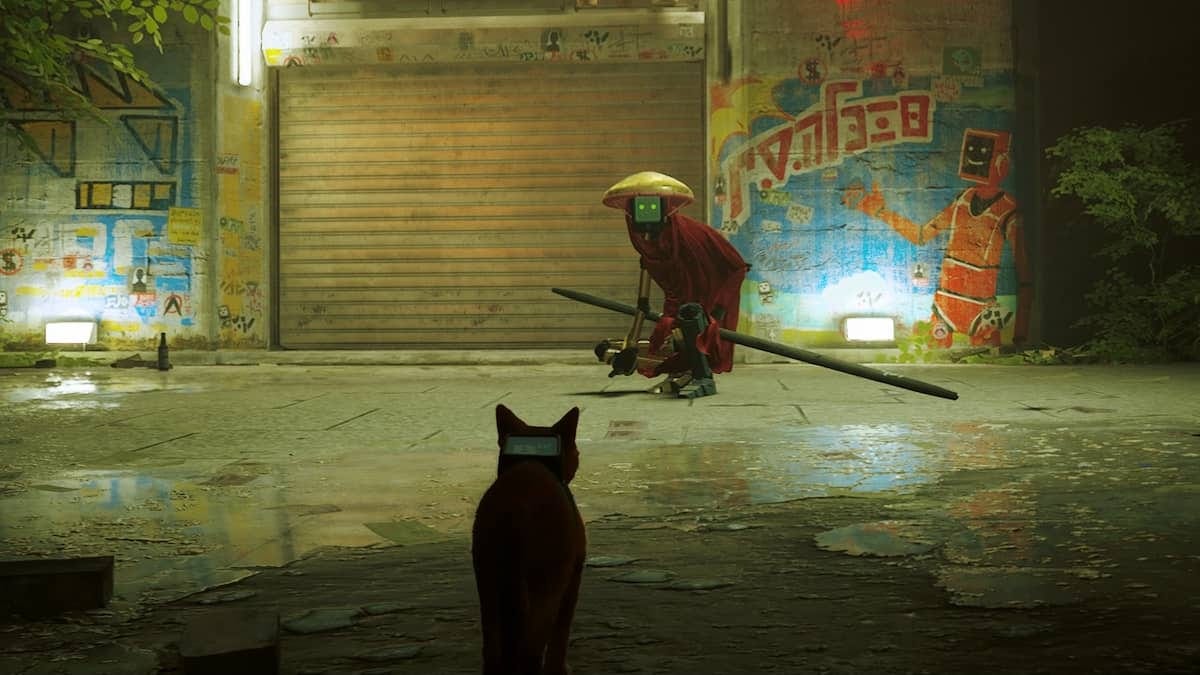
When you wake up your leg is all better, thank God, but now you’re in a scary dark tunnel and concerned for orange cat’s safety in this situation. It’s here that the game really begins. After a few minutes of tunnels and a sequence in which you’re chased by these horrible sentient blobs called Zurks, you find yourself in “The Walled City,” a cyberpunk dystopia populated entirely by robots. The city is at once beautiful and trite. The lovely ambient score creates a sense of wonder and mystery as the kitty slinks and pounces through various urban impediments, but the aesthetic itself is the fairly rote “Cyberpunk with Chinese Characteristics” you’ve seen a thousand times by this point. It’s a minor gripe, as not long after arriving in the city you discover that the developers are really getting into this whole “cat” thing. You can walk all over a keyboard producing garbage nonsense text to appear on the monitor. This is so well done that I reloaded the checkpoint to see if a different text came up the next time I walked over it, and what do you know, it was different each time. The devs have placed a variety of rugs and chairs and doors around the place for you to scratch on. It does literally nothing, but it’s weirdly irresistible each time the prompt comes up. Of course, the best mechanic is you can knock objects off various edges with your paw. You can do it for no reason like a cat might, or you can do it to advance the game as a puzzle might require. There’s an elegance to the way the puzzles and the platforming are woven into the idea of playing as a cat. While you the player are engaging in abstract thought; the presentation of the game, the way the puzzles and platforming are actioned by the protagonist, engenders a sense that this cat is accomplishing these things almost by accident. That orange cat just does things, and they happen to be correct. Nonetheless, you can’t quite shake the feeling that this feline could qualify for a MacArthur grant. Luckily, right when that moment arrives, you meet a robot.
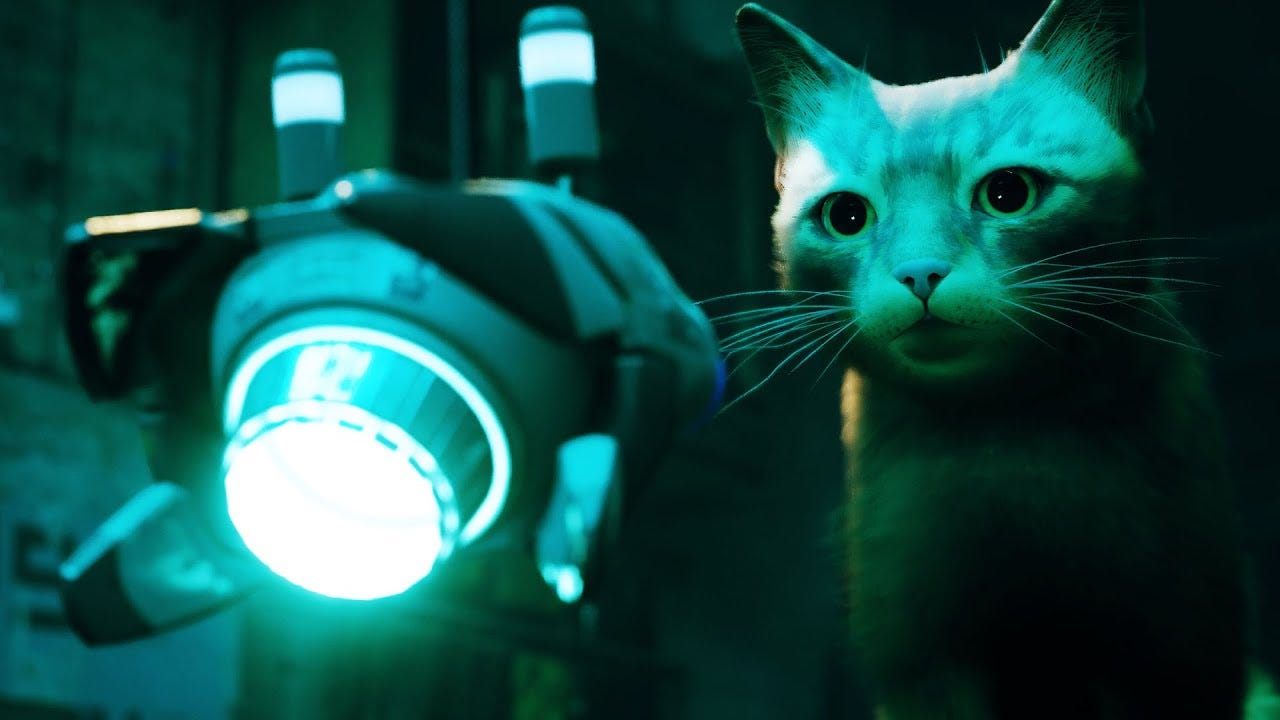
B-12, isn’t as cute as orange cat, but he’s pretty cool for a robot. He’s like a little flying owl head and you find him in a random flat you stumble into. His problem is he can’t remember who he is or why he exists, and decides his best option is to team up with a cat to solve this mystery. He equips you with a little harness that has a pocket for him to fit in. He can speak both cat and robot and is able to translate things to you. As you traverse the Walled City you’ll encounter various, objects, artworks, graffiti, and documents which B-12 can investigate to piece back together his memories. The mechanic reminded me a lot of another indie game Her Story, which I recommend you play without knowing anything about. B-12 is effective in closing the gap between the cat’s abilities in-game and the player’s, turning off that voice that says "there’s no way a cat could work a vending machine,” because now he’s rolling with a robot. Shortly after meeting your new buddy, orange cat is introduced to the inhabitants of the city: the other robots. This is a crucial moment for the game. Are these evil robots? Are these glorified washing machines? How anthropomorphised are they going to be? Do they like cats? The answer is the robots are super chill, bordering on sombre, slightly childlike and simultaneously curious yet nonplussed about the cat’s existence. They have a charming retrofuturistic design with big 1990s monitors for heads and wiry bodies hidden beneath cloaks and ponchos. They’re the outline of a human being, making them at once empathetic yet alien. Humans, or “Soft Ones,” have been gone from the city for some time. The robots miss them, terribly in fact, speaking of them as lost loved ones as graffiti on the city walls reads “RIP HUMANS.” The kind-hearted machines are refreshing in an age where we should be seriously concerned about computer sentience.
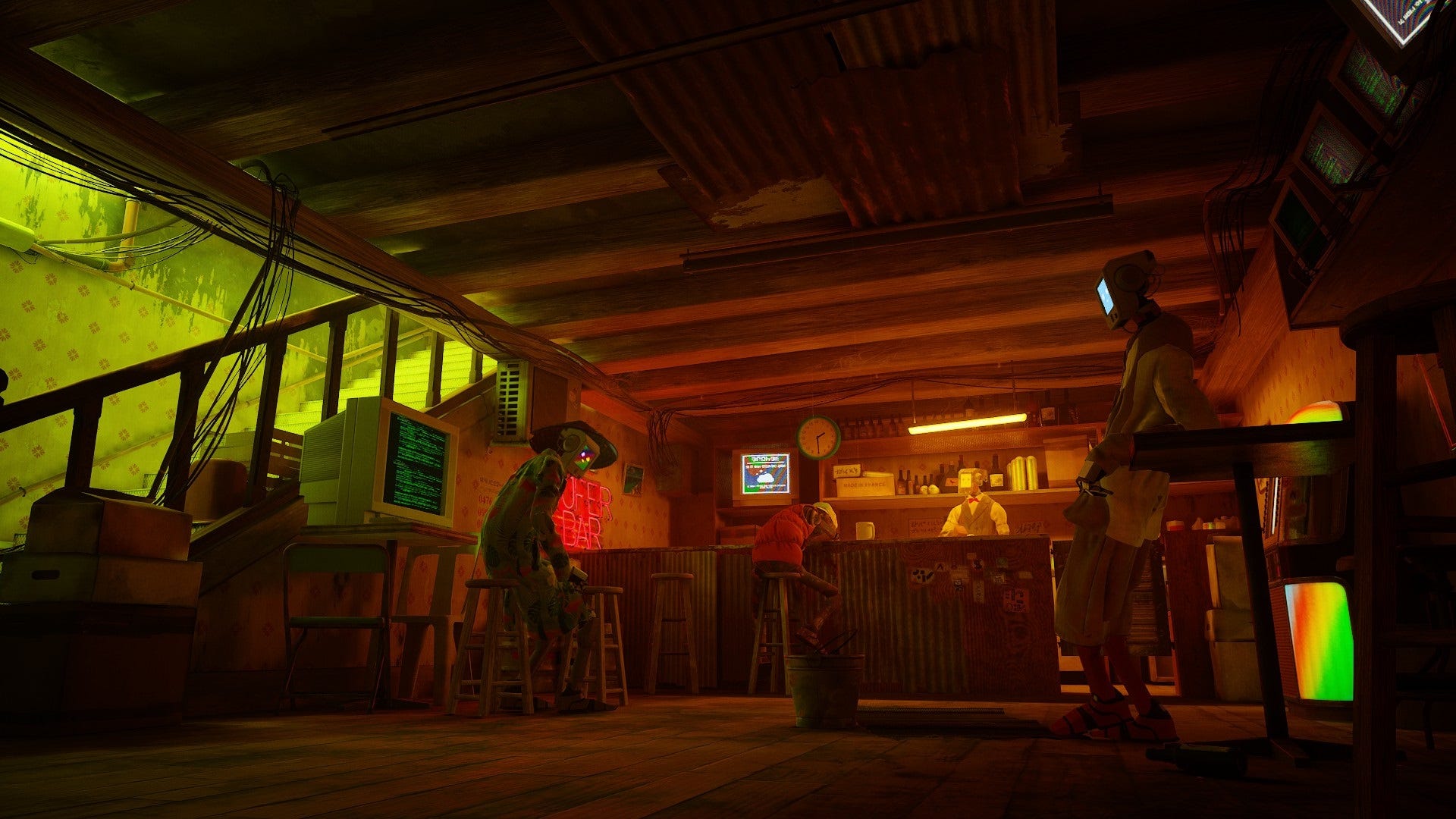
It’s at this point that the game begins to oscillate between linear levels and more open sandboxes. The level design in the linear passages is generally intuitive. I never feel like I’m wandering through a maze I never signed up for, and the developers make good use of environmental cues, light, and space to guide you where you need to go. That said sometimes the game opts to just stick a big arrow to pointing to THE CORRECT DIRECTION, which isn’t anything novel, but it’s hardly organic design. The sandbox sections eschew breadth for verticality. It’s an absolute joy to leap from the sidewalk to the top of a tower with well-placed jumps onto air conditioners and windowsills. The view from the top is consistently gorgeous and the airy electronic instrumentals fit the mood like Cream does a fifty bag. The level objectives reflect the altered level design in the sandbox. Whereas once you were passing through a series of tubes, now you find yourself completing objectives and collecting items for other characters. It might be a series of fetch quests, but in the process it’s effective in connoting the world, painting it in steaks as you leap around a decaying metropolis. The maps themselves aren’t particularly wide, but the developers use the tiny size of orange cat to great effect. The placement of the camera consistently reinforces your size and vulnerability against the Teutonic geometries of the city. Travelling thirty feet is a lot for a cat, but every inch of neon-stained concrete you cross feels lived in and relevant. It’s a lot like Arkham Asylum where the environment is compact but dense. Everywhere you go there’s a robot to talk to, a thing to look at, a memory to collect, or a bed to lie on and take a nap for no reason whatsoever. He even purrs softly as he sleeps.
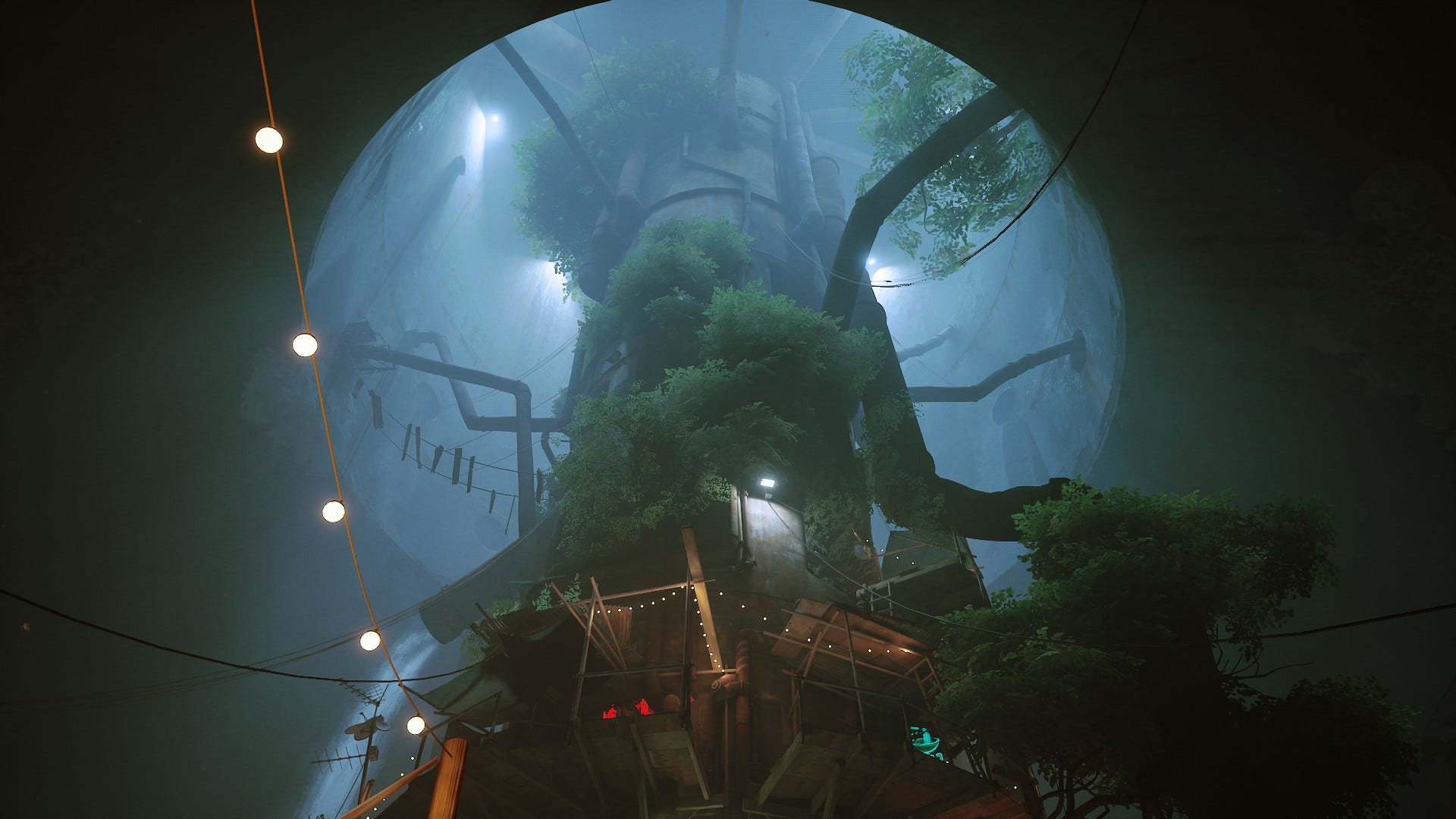
After meeting the amiable leader of the slum robots Momo, you’re introduced to the plot proper. The Walled City was once occupied by both humans, robots and presumably cats, living together in harmony. At some stage an environmental catastrophe necessitated the city being placed under a dome, as the outside world had become toxic. The humans died, but the robots became sentient and had to fend for themselves. Those trapped in the slums wish to leave, but great swathes of the city are overrun with Zurks and this creeping, genuinely unsettling biological ooze that crawls up the walls and coalesces into a thousand massive staring eyeballs. Few in the slums have left for some time, and those that tried have never come back. However, the presence of a new cat on the scene suggests the outside might be survivable now. The robots are in such awe at orange cat’s abilities, promising him that they, six-foot machines made of steel, will be brave for him. It’s incredibly sweet. You set out to find those few courageous robots who attempted to escape the city. You reunite one with his long-lost father, a scientist, who rewards you with a means to fight the Zurks. It’s basically a purple flashlight that works like a gun in Mass Effect one. You point it at Zurks to make them explode, but there’s a cooldown after a certain time period instead of running out of ammo. With your newly acquired arsenal, you’re sent off in search of Clementine, a pioneer of sorts in the robot-liberation-from-the-city movement. After fighting your way through a Zurk-infested sewer you arrive in the beautiful arboreal hamlet Antvillage. It’s built like a high-rise treehouse and is a wonderful visual pallet cleanser from the sewers and the slums. Immediately you’re hit with a big plot development: B-12 isn’t a robot, he’s a human being who uploaded his consciousness into the device when struck with a terminal illness. Such a large narrative beat should suggest that Antvillage plays a significant role in the story, but it doesn’t really. After speaking with one robot and completing a single side quest you’re literally a hop, skip and jump away from the final major sandbox Midtown.
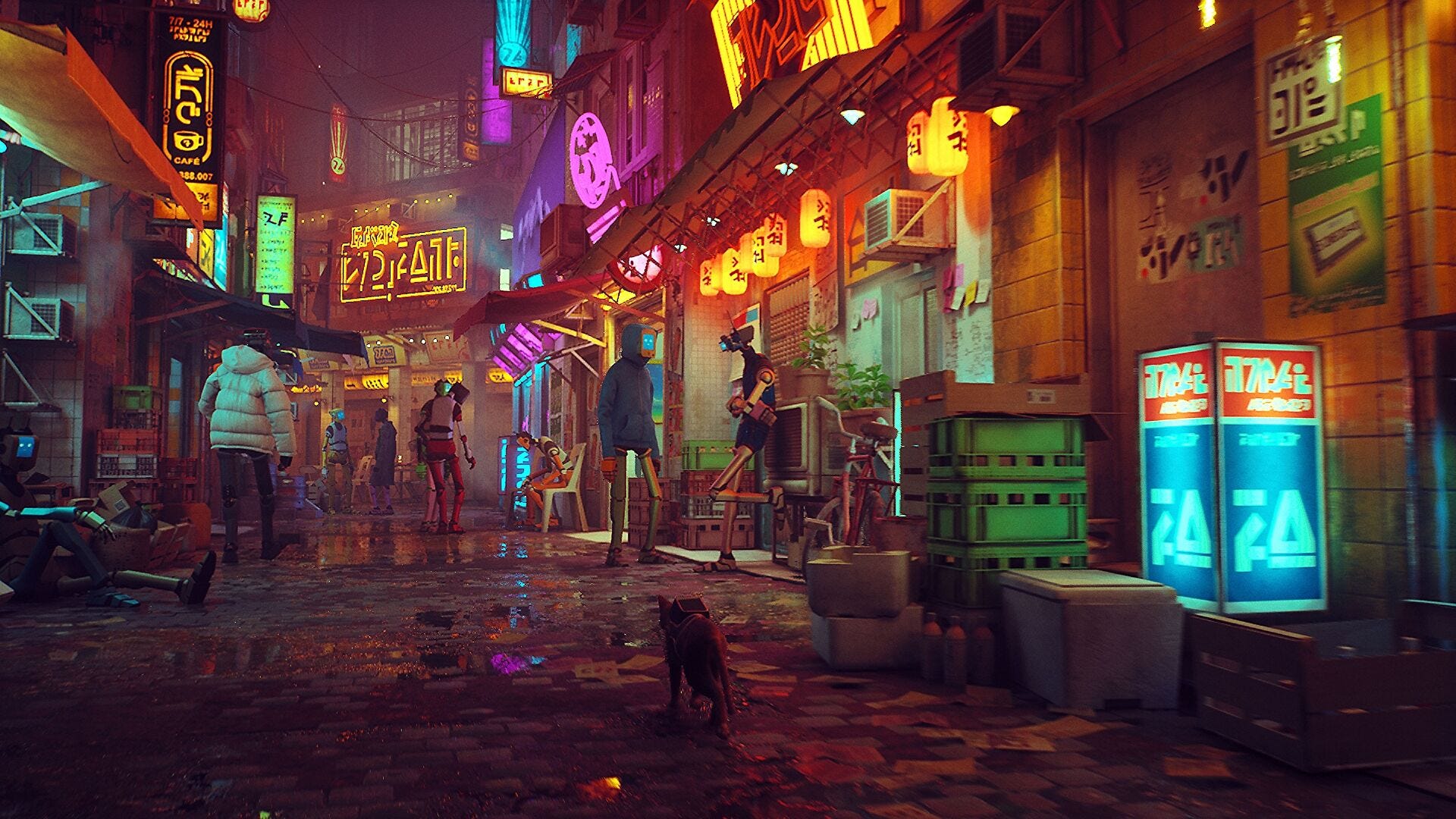
You immediately notice three things in Midtown: If you see a box you can sit in it, more neon means more cyberpunk, and some of these robots aren’t as nice as the others. While most of them are the kind and gentle automatons from the slums, added to the mix are now policebots and crimebots, rapperbots and the dreaded sentinels, evil floating video cameras that’ll light your arse up if you pass inside their field of vision. The sentinels bring with them another gameplay mechanic, stealth. Both the stealth mechanics have been lifted from Metal Gear Solid one: Avoid the enemy line of sight and hide in a box. In a game that parroted at least three lines from Skyrim, as like a reference, I was really hoping for someone to complain about Solid Cat during the stealth sections but alas. After finding Clementine you connect with her associate Blazer. He asks you to help him infiltrate a thing, to get the thing, and activate the thing… y’know video game stuff. Blazer, despite being dressed like an utter scumbag, turns out to be an utter scumbag and after an excellent nightclub level, he sells you and Clementine out to the sentinels. You’re thrown in jail, B-12 is taken from you, and you’re placed in a tiny cage suspended by a cable over a lake of toxic sludge. Animal cruelty. You pretty swiftly escape, reunite with B-12 and Clementine, who provides you with access to the “Control Room.” Despite being a suspicious cat you can breeze on through the final area with no resistance whatsoever. I wouldn’t call it so much an anticlimax as a bait and switch. The game gradually ratcheted up the threat posed by the enemies, leading to the lead-riddled “Jail” chapter. The final level is calm and considered, and bereft of any direct threat, and placed in a stark, white, Portal-like environment. The robots you encounter are the factory models that never gained sentience. Instead of normal names like “Momo,” they’re called “Helper 45-B,” and they speak to you only in the basic, polite, yet indifferent prompts you might get from your smart-microwave. I find this choice to turn down the heat at the apotheosis the better option in a game which shines more brightly in its quieter moments. The final puzzle, the opening of the dome on the Walled City, incorporates many of those inane cat things the game has left you to have fun with hitherto. It’s a satisfying culmination of character, narrative and gameplay that did indeed make me want to play through again. It ends on a touching note of freedom and curiosity. But of course it did. It’s a game about a cat.
Your enjoyment of this game is going to rest on two things: Whether you like cats, and how invested you are in pressing a button to make a cat do cat things. Platforming fans are gonna be let down. You press “A” and the cat makes the jump ten times out of ten. It’s better to think of the game as more of an adventure puzzle game with stealth and platforming elements, one with an adorable protagonist and a charming supporting cast. It’s a vibe. For me, even if I was a little done with a level, the fact that I had the option to just press “Y” and take a random nap for as long as I liked, in an incredibly inconvenient place for everyone else more than made up for it. Your mileage may vary, but I got six hours of a well-realised world filled with fun NPCs and a few neat puzzles out of my forty bucks and I’m largely satisfied. I kinda want a cat now though.